
ProductSolutionsPricing
Solutions & Use Cases

One platform. Many ways to put it to work.

Start with the operational problem that hurts most—winning work, coordinating delivery, managing resources, controlling cost, reducing risk or improving visibility—and connect more of the workflow over time.

Customer→Proposal→Project
Tasks→Resources→Time
Cost→Risk→Payment
Compliance→Reports→Analytics
Solutions by business type

The same connected data model, shaped around different operating realities.

Each business can enter Taskeeper at a different point. The value grows as customer, project, people and commercial workflows become connected.

01

Construction companies

Coordinate live projects, site actions, teams, suppliers, documents, budgets and customer payments.

Typical starting problems

  • Too many jobs tracked in spreadsheets
  • Site actions disappear into messages
  • Supplier and cost information is disconnected
  • Management cannot see current project position
Customer → Project → Tasks → Suppliers → Payment
View solution →Explore solution →
02

Engineering companies

Connect technical delivery with resources, hours, documentation, risk and project economics.

Typical starting problems

  • Resource allocation is hard to understand
  • Time and delivery cost are reconstructed later
  • Technical documents sit outside project controls
  • Risk and delivery reporting are separate
Proposal → Project → Resources → Time → Analytics
View solution →Explore solution →
03

Architecture & design practices

Keep client relationships, proposals, projects, design evidence, resource time and commercial follow-up connected.

Typical starting problems

  • CRM information is separate from project delivery
  • Fee proposals and project work lose context
  • Documents are difficult to trace to project decisions
  • Team time is hard to compare with project value
Interaction → Proposal → Project → Documents → Time
View solution →
04

Developers & owners

Gain portfolio-level visibility over delivery status, budget position, risk, compliance and payments.

Typical starting problems

  • Updates arrive in different formats
  • Portfolio risk is difficult to compare
  • Commercial and delivery status diverge
  • Management reporting is labour-intensive
Portfolio → Project → Budget → Risk → Insight
View solution →
05

Project management teams

Maintain ownership, deadlines, evidence, risks, compliance and commercial context across delivery.

Typical starting problems

  • Action owners are unclear
  • Status reporting consumes too much time
  • Risk mitigation sits outside task delivery
  • Closeout evidence is fragmented
Plan → Assign → Monitor → Escalate → Report
View solution →
06

Specialist contractors

Connect quotations, technical tasks, assigned resources, evidence, external cost and payment milestones.

Typical starting problems

  • Technical jobs create heavy admin
  • Evidence and approvals are hard to trace
  • Labour effort is separated from job economics
  • Compliance and risk must be demonstrable
Quote → Technical Work → Evidence → Cost → Payment
View solution →
Use cases by business problem

You do not need to implement everything at once.

Win workCRM · interactions · proposals

Maintain customer context and reduce the handoff gap between commercial activity and delivery.

Coordinate deliveryProjects · tasks · Gantt · Kanban

Give actions owners, dates, status and project context.

Manage capacityResources · skills · pricing · time

Understand who is doing the work and what that effort represents.

Control moneyBudget · suppliers · cost · payments

Keep project economics closer to operational progress.

Reduce surprisesRisk · mitigation · escalation · compliance

Make risk and governance part of delivery rather than a separate periodic exercise.

Report with less reconstructionAnalytics · reports · documents

Use connected operational data as the basis for management insight and project outputs.

See the platform

Use cases connected to the Taskeeper workspace.

The stories below map business workflows to the same project, people, time, commercial and risk controls teams use across Taskeeper.

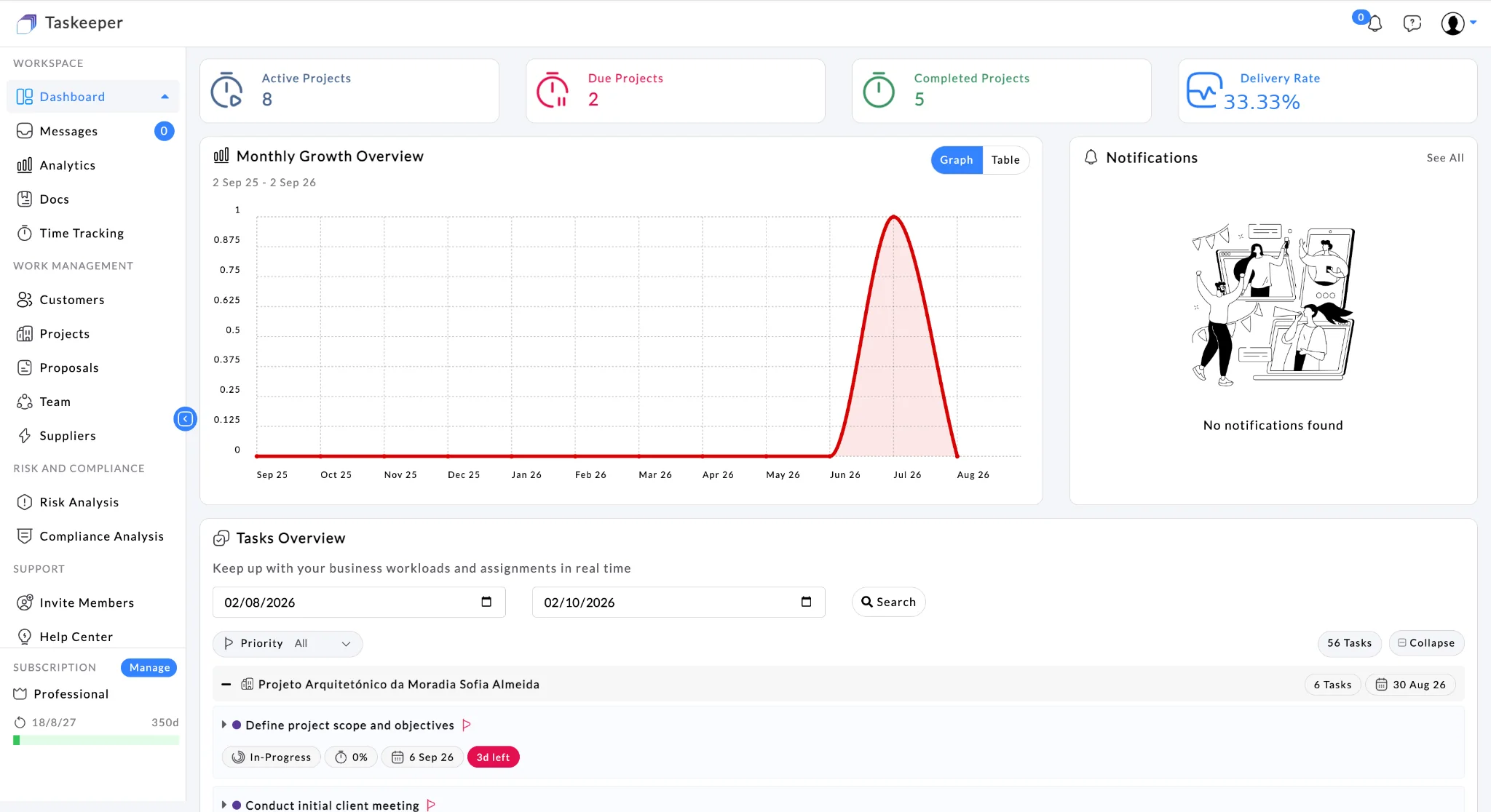
Taskeeper dashboard showing the operational picture across projects and tasks

Operational control

Dashboard-level visibility across projects, capacity, time and delivery risk.

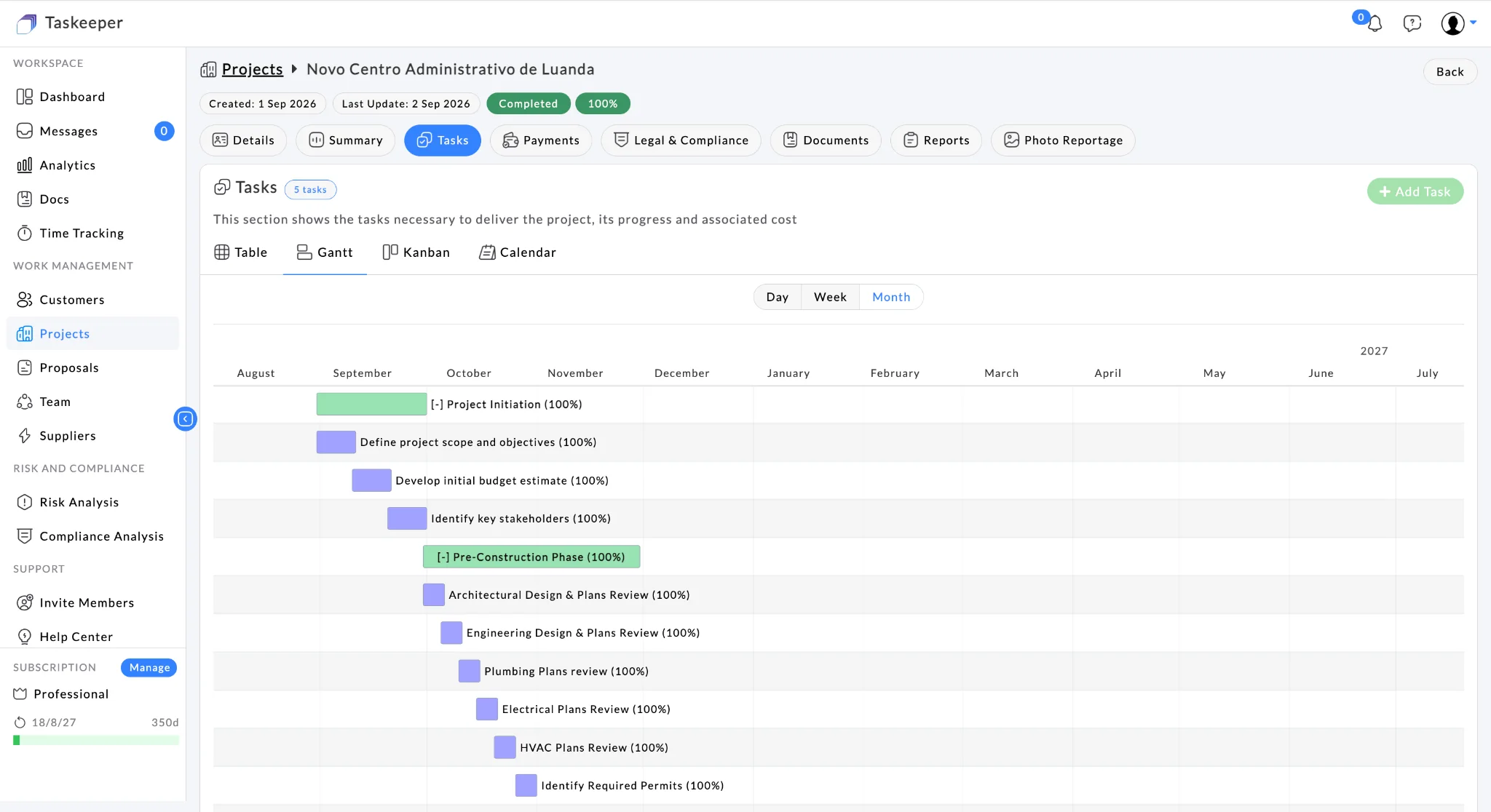
Taskeeper project Gantt view showing task sequencing and delivery planning

Project delivery workflow

Project planning, task/resource allocation, time tracking and reporting views.

Use case library

18 ways Taskeeper can support real-world workflows.

Explore practical operating models across construction, engineering, architecture, development, specialist contracting and project management.

01Construction

Lead-to-completion control

Residential contractor

A regional home builder replaces separate spreadsheets, WhatsApp threads and payment notes with one connected workspace for a new-build project.

Customer → Proposal → Project → Tasks → Suppliers → Payment
Customer & proposalProject/task deliverySupplier costPayment milestones
02Architecture / Design

Client brief to design delivery

Architecture studio

A 12-person architecture practice keeps client interactions, proposal history, project requirements, design documents and team time connected across multiple commissions.

Interaction → Proposal → Project → Documents → Time
CRM / interactionsProposalsDocumentsTime sheets
03Engineering

Multiple crews, one operational picture

Civil engineering contractor

A civil works business coordinates several active sites, assigns engineering resources, uses Gantt/Kanban views and escalates delivery risks before they affect programme dates.

Project → Tasks → Resources → Risk → Analytics
Multi-project deliveryResource assignmentRisk escalationAnalytics
04Specialist Contractor

Quote to technical handover

MEP specialist

An MEP subcontractor connects quotation context with technical tasks, assigned engineers, evidence, external supplier cost and final payment milestones.

Proposal → Technical Tasks → Evidence → Cost → Payment
Proposal handoffTechnical tasksDocuments / evidenceCommercial control
05Construction

Fast-moving jobs without admin sprawl

Fit-out & refurbishment firm

A fit-out contractor manages many shorter-duration jobs with client requirements, task ownership, supplier services, budget position and milestone collection in one place.

Customer → Project → Tasks → Suppliers → Budget → Payment
Fast project setupTask ownershipSupplier servicesBudget/payment
06Developer / Owner

Portfolio oversight across developments

Property developer

A developer uses Taskeeper to keep project status, planned budgets, payments, open risks and delivery context visible across a small portfolio without waiting for separate status reports.

Portfolio → Project → Budget → Risk → Insight
Project portfolioBudget positionRisk statusAnalytics
07Engineering

Know what technical delivery is costing

Engineering consultancy

A consultancy connects skills, pricing tiers, task assignments and monthly timesheets so project managers can see resource effort alongside delivery and financial performance.

Skills → Assignment → Time → Cost → Analytics
Skills/pricingAllocationTime trackingProject cost
08Construction

Seasonal teams and supplier-heavy delivery

Landscape contractor

A landscaping company coordinates crews, external suppliers, project tasks, working time and staged customer payments across several concurrent outdoor projects.

Project → Crew → Suppliers → Time → Payment
Resource planningSuppliersTime sheetsMilestones
09Architecture / Design

Design, procurement and client delivery

Interior design practice

An interior design studio manages client interactions, proposals, design projects, documents, supplier services and project budgets without splitting the job between CRM and project tools.

Client → Proposal → Design Project → Documents → Supplier Cost
Client CRMProposalDocumentsSupplier cost
10Specialist Contractor

Make compliance part of project control

Compliance-heavy contractor

A regulated specialist contractor tracks compliance status and risk mitigation alongside the tasks and documents that prove work is being delivered correctly.

Project → Compliance → Risk → Tasks → Evidence
Compliance KPIsRisk/mitigationTask ownershipDocuments
11Developer / Owner

Group-level operating consistency

Multi-company construction group

An enterprise group standardises project, role and reporting practices across multiple companies while maintaining a common commercial and delivery operating model.

Company → Projects → Permissions → Analytics
Multi-company environmentAdvanced rolesAdmin controlsAnalytics
12Construction

Replace the spreadsheet + messaging stack

Small owner-led contractor

A small contractor starts with customers, live jobs and task ownership, then gradually adds proposals, suppliers, budgets and payments as the team adopts the platform.

Customer → Project → Tasks → Expand
Low-friction starting pointCustomer contextTask ownershipProgressive adoption
13Project Management

Turn a slipping project into an action plan

Project recovery / troubled job

A project manager uses overdue tasks, delivery views, open risks, budget position and payment status to identify what needs escalation and assign corrective actions.

Overdue Task → Risk → Owner → Mitigation → Budget Review
Task statusRisk escalationBudget visibilityManagement review
14Construction

Keep external cost with the work it supports

Supplier-intensive project

A contractor keeps supplier services and external parties linked to project delivery so commercial teams can see where outside cost is being incurred.

Project → Supplier Service → Task → Cost → Budget
Supplier managementExternal costTask contextBudget control
15Project Management

Close the project with the evidence intact

Project handover & closeout

A project team gathers final documents, photo progress, reports, compliance context and outstanding payments before moving the job into completed status.

Tasks → Documents → Photo Evidence → Compliance → Payment → Report
DocumentsPhoto progressComplianceReports/payments
16Project Management

Spend less time rebuilding status packs

Client-facing project reporting

A project manager uses current project, task, budget, risk and delivery information as the source for recurring client and management reporting instead of manually reconciling separate spreadsheets.

Project Data → Delivery Status → Risk → Financial Position → Report
Project statusRiskBudget/paymentReports
17Engineering

A common operating model across borders

International project team

An international engineering organisation uses shared project structures, resources, roles and configurable language/currency settings to reduce operational variation between teams.

Organisation → Roles → Projects → Resources → Reporting
Roles/adminProjectsResourcesInternational settings
18Architecture / Design

Coordinate multidisciplinary design delivery

Architecture + engineering joint delivery

A multidisciplinary design team connects project requirements, architecture and engineering tasks, documents, resource time and design-stage risks in a shared project context.

Requirements → Tasks → Disciplines → Documents → Time → Risk
RequirementsTask ownershipDocumentsTime/risk
Four end-to-end patterns

Common workflows that cut across industries.

01

Lead to project

Customer → interaction → proposal → project → tasks.

Useful for contractors, architects, engineering consultancies and design firms.
02

Resource to cost

Resource → skill/pricing → task assignment → timesheet → project cost.

Useful where labour effort is a major part of project economics.
03

Risk to action

Risk → likelihood/impact → owner → mitigation → escalation → issue.

Useful on complex, regulated or schedule-sensitive work.
04

Delivery to cash

Project → task progress → budget/cost → milestone → payment → analytics.

Useful for teams that need project and commercial visibility together.
Use-case design principle

Start narrow. Connect the workflow when the value is proven.

A small contractor may begin with customers, projects and task ownership. An engineering firm may start with resources and time. A developer may start with portfolio, risk and budget visibility. The platform becomes more valuable as those operational records connect.

Phase 1Solve one visible workflow pain
Phase 2Connect the adjacent records
Phase 3Use the combined data for control
Phase 4Use analytics to improve decisions
Find your starting workflow

Show us how your team works today.

We can map your current customer-to-project or project-to-payment process to the Taskeeper capabilities that matter first.